What is south?
The only continent on Earth where independent travel is restricted by international treaty. The most heavily fortified, least-explored, and most institutionally guarded landmass in human history.
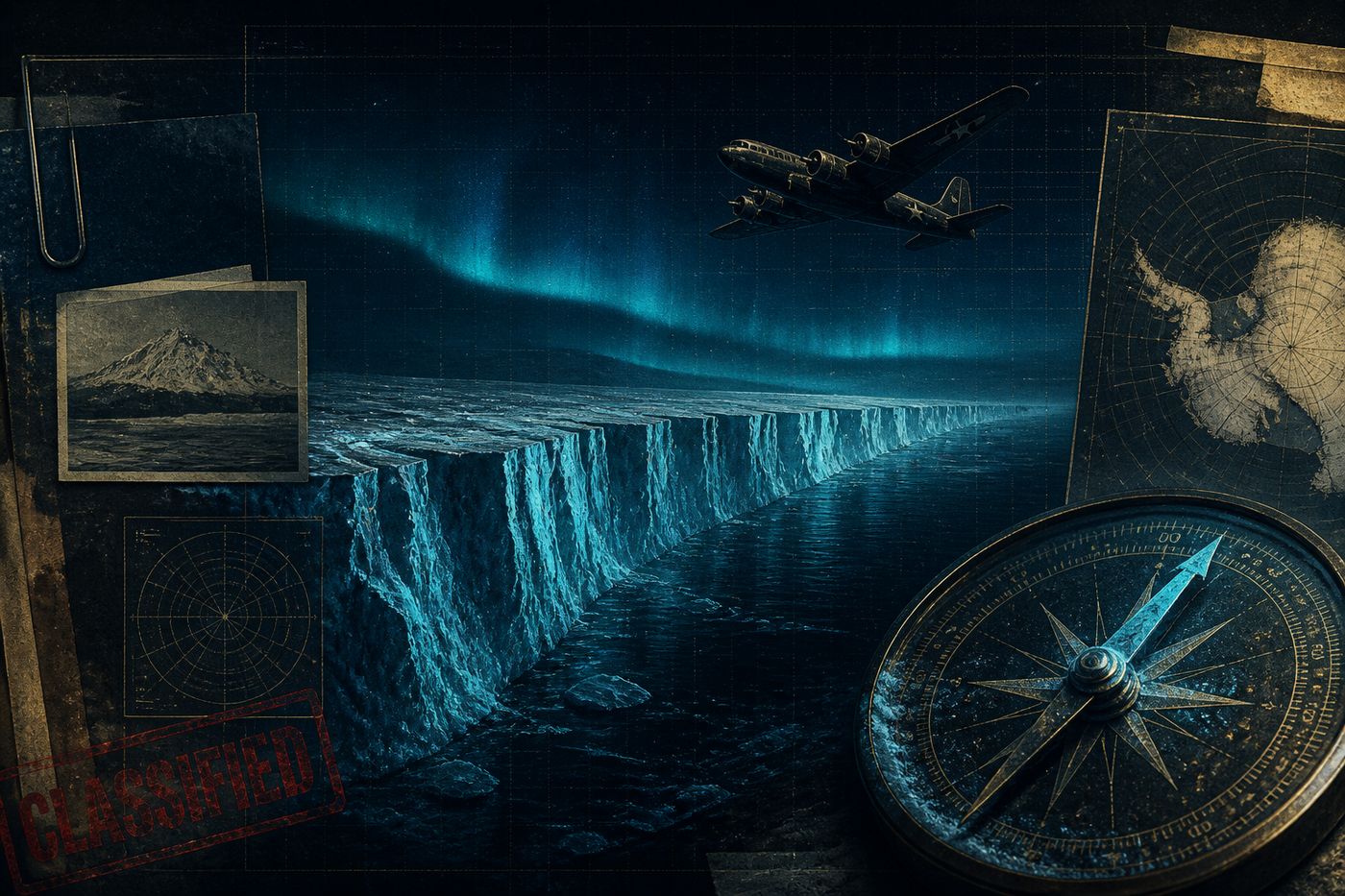
Operation Highjump (1946–1947)
Operation Highjump, officially the United States Navy Antarctic Developments Program, was led by Rear Admiral Richard E. Byrd between August 1946 and February 1947. It deployed 4,700 troops, 13 ships including an aircraft carrier (USS Philippine Sea), and 33 aircraft.
This is, by orders of magnitude, the largest military expedition ever sent to Antarctica. The stated purpose was scientific exploration and training in cold-weather operations. The expedition was scheduled to last six to eight months. It was aborted after eight weeks under unexplained circumstances.
Specific aircraft were lost. Specific personnel died. The official records of the operation were classified for decades, and many remain partially redacted. Byrd himself never publicly discussed what caused the early termination.
The "Land of Everlasting Mystery" Interview
In 1955, Admiral Byrd gave an interview that included a statement repeatedly quoted in independent research literature:
"I'd like to see that land beyond [the South Pole]. That area beyond the Pole is the center of the Great Unknown. I'd like to do that exploration. It is the most inaccessible area in the world."
Byrd subsequently referenced "land beyond the Pole" — a phrase that, taken literally, is geometrically impossible if the South Pole is the southernmost point on a sphere. There is nothing "beyond" a pole on a globe.
On the flat-plane model, where the disk extends outward from a central North Pole and Antarctica is the perimeter ice wall, "beyond the South Pole" makes geographic sense — it would be the unexplored regions outside the conventional Antarctic boundary.
The Antarctic Treaty (1959)
Signed initially by 12 nations and now ratified by 54, the Antarctic Treaty entered into force in 1961. Among its provisions:
- Prohibits military activity, weapons testing, and nuclear waste disposal in Antarctica
- Restricts independent travel to the continent without state authorization
- Establishes a coordinated multinational scientific research framework
- Permits only authorized expeditions; private exploration south of 60° latitude requires permits
The treaty has been renewed and extended. The current framework prohibits independent crossing of latitude 60° South — meaning private aircraft, ships, and explorers cannot legally enter without authorization. Tourism is permitted only via approved cruise operators following established routes.
This is a documented fact, not a conspiracy theory. The question — and the only question — is why this specific continent, alone among Earth's landmasses, is restricted in this way.
The Standard Explanation
The official rationale for the Antarctic Treaty is environmental protection and the prevention of resource exploitation. This is internally coherent. It would also be coherent for, say, the Amazon rainforest, the Arctic Ocean, or any other ecologically sensitive zone — none of which are restricted by international treaty in the same way.
The treaty also predates most modern environmental movements by decades. The 1959 framework was negotiated in the immediate aftermath of Operation Highjump, the IGY (International Geophysical Year), and a series of military operations whose details remain partially classified. The environmental framing came later.
Independent Verification Is Banned
If you wanted to circumnavigate the South Pole today — by yourself, in your own boat or plane — you cannot. The treaty's enforcement provisions, combined with the natural difficulty of polar travel and the absolute lack of refueling infrastructure, mean that no private expedition can verify the conventional model independently.
Every "verification" of the South Pole's existence comes from authorized state expeditions. Every aerial photograph comes from ICAO-approved commercial routes that arc near but not over the pole. Every map of the continent's interior comes from US, UK, Russian, and Norwegian research stations that operate under treaty authority.
This is not a small detail. In every other domain — medical research, archaeological digs, deep-sea exploration — independent verification is a foundation of credible knowledge. In this one domain, it is structurally prohibited.
The treaty's existence does not "prove" the flat-earth model. It does establish that the public has been denied the means to independently verify a key claim about the planet's geometry. A world where the data is unfalsifiable by design is a world where any cosmology is, in principle, defensible by appeal to "the data the public can't access." The flat-earth model is not the cause of this asymmetry. The treaty is.
Notable Subsequent Events
- 1961: Treaty enters into force.
- 1969: Apollo program declared complete; original telemetry tapes "missing" by 2006.
- 1980s–present: Continued restriction on private polar exploration. Notable attempts (e.g., Jarle Andhøy's Berserk incidents) result in legal confrontations with the New Zealand and US authorities patrolling the boundary.
- 2016: Secretary of State John Kerry visits the South Pole — the first sitting Secretary of State to do so. No public explanation given for the visit's purpose.
- 2017: Buzz Aldrin medically evacuated from McMurdo Station after a brief tourist visit. Subsequent statements were widely circulated; Aldrin denied making them. The controversy remains.