Why did the United States fire nuclear weapons straight up?
Operation Fishbowl, July–November 1962, was a series of high-altitude nuclear detonations conducted by the US in the upper atmosphere. The stated purpose was weapons effects research. The pattern of the tests — and what they may have been testing for — has remained a topic of independent investigation.
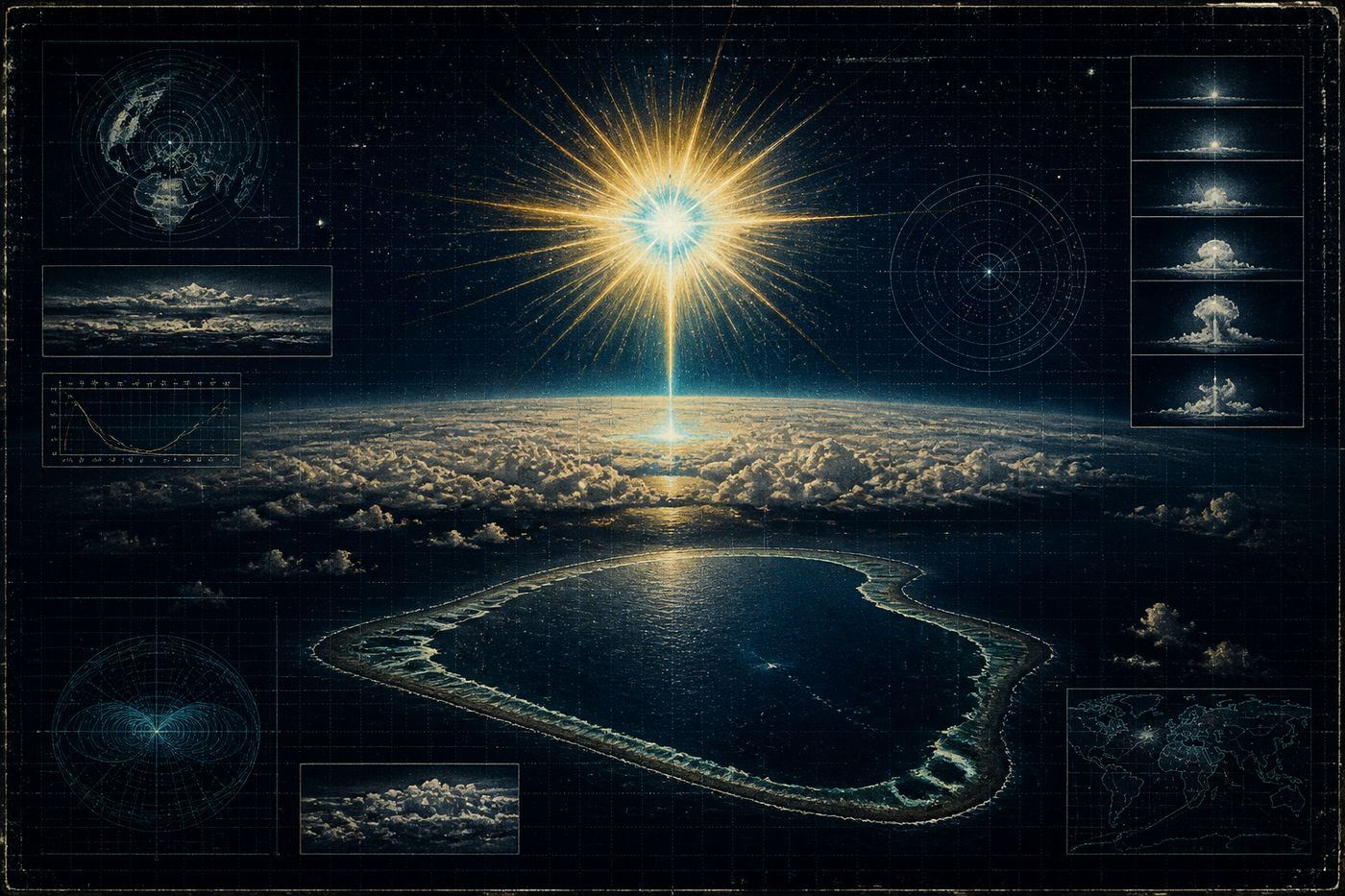
The Tests
Operation Fishbowl consisted of five successful detonations between July and November 1962:
- Starfish Prime (July 9, 1962) — 1.4 megatons at ~250 miles altitude. The largest of the series.
- Checkmate (October 19, 1962) — Smaller yield, different altitude, different effect studied.
- Bluegill Triple Prime (October 25, 1962) — After two failed earlier attempts.
- Kingfish (November 1, 1962) — Higher altitude.
- Tightrope (November 4, 1962) — Lower altitude.
The official designation was "high-altitude nuclear weapon effects testing." The purpose: study the effects of nuclear detonations on radio communications, satellite electronics, and atmospheric ionization.
Starfish Prime — What Happened
Starfish Prime detonated 250 miles above Johnston Island in the Pacific. The 1.4-megaton blast produced effects far beyond what was anticipated:
- An auroral display visible from Hawaii (over 800 miles away)
- Satellite damage that disabled at least one-third of all satellites in low-Earth-orbit at the time
- Electromagnetic pulse effects on Honolulu's electrical grid (streetlights blew out, telephone communications disrupted)
- An artificial radiation belt that persisted in Earth's near-space environment for years
The unexpected magnitude of these effects led to the de facto halt of high-altitude nuclear testing — a halt formalized two years later in the 1963 Limited Test Ban Treaty.
The Independent Hypothesis
The conventional history says the test was bigger than expected and the consequences spooked policymakers. Independent researchers have proposed a different reading: the tests were probing the upper atmosphere for the existence of a physical structure — what the Hebrew, Egyptian, and ancient cosmologies called the firmament.
On this hypothesis, Operation Fishbowl's targets weren't merely "high-altitude" — they were aimed at progressively higher altitudes (50 miles, 100, 250) to map at what altitude resistance, deflection, or unexpected interaction occurred. The purpose was to determine whether something physical lay above the atmosphere.
Whether this hypothesis is correct or not, the test pattern is consistent with such an investigation. The official rationale (weapons effects research) is also consistent. Both readings fit the documented test sequence.
The Geometry Question
Several details of Starfish Prime are difficult to reconcile with the conventional model:
- The auroral effect was visible from Hawaii — over 800 miles from the detonation point. Aurora is supposed to require Earth's magnetic field to channel charged particles into the upper atmosphere. The aurora produced by Starfish Prime was geographically distributed in a way that doesn't cleanly fit the standard auroral mechanism.
- Satellite damage was widespread, but the satellites supposedly orbited at altitudes well above the detonation. Damage from the detonation should have been geographically localized; observed damage was global, with satellites on the opposite side of the planet from the test affected.
- The "artificial radiation belt" persisted for years. On the standard model, charged particles in low-Earth-orbit should have decayed back into the atmosphere within days or weeks. Their persistence was unexpected, and the explanation involves several auxiliary assumptions about the Van Allen belt structure.
What Came After
The 1963 Limited Test Ban Treaty prohibited atmospheric, underwater, and exoatmospheric nuclear testing. The treaty was ratified by the US, USSR, and UK; France and China did not sign. Subsequent tests were limited to underground detonations.
In 1967, the Outer Space Treaty further prohibited the placement of weapons of mass destruction in orbit or on celestial bodies. By the late 1960s, the door on high-altitude exoatmospheric nuclear research was effectively closed at the international policy level — and the Apollo program's claims of moon landings were beginning.
The Open Questions
- What were the original Operation Fishbowl scientific objectives in their pre-classification form? (Many documents remain partially redacted.)
- Why was the operation halted not after the failed early Bluegill attempts, but after Starfish Prime — the largest and most ambitious test?
- What relationship, if any, did Operation Fishbowl have with the parallel push to legally close exoatmospheric testing under the LTBT?
The institutional record is incomplete by design. The independent record is suggestive but not conclusive. What we can establish: the United States, in 1962, fired five nuclear weapons straight up, in a sequence of progressively higher altitudes, and the results led directly to a global treaty closing the area to further investigation.